
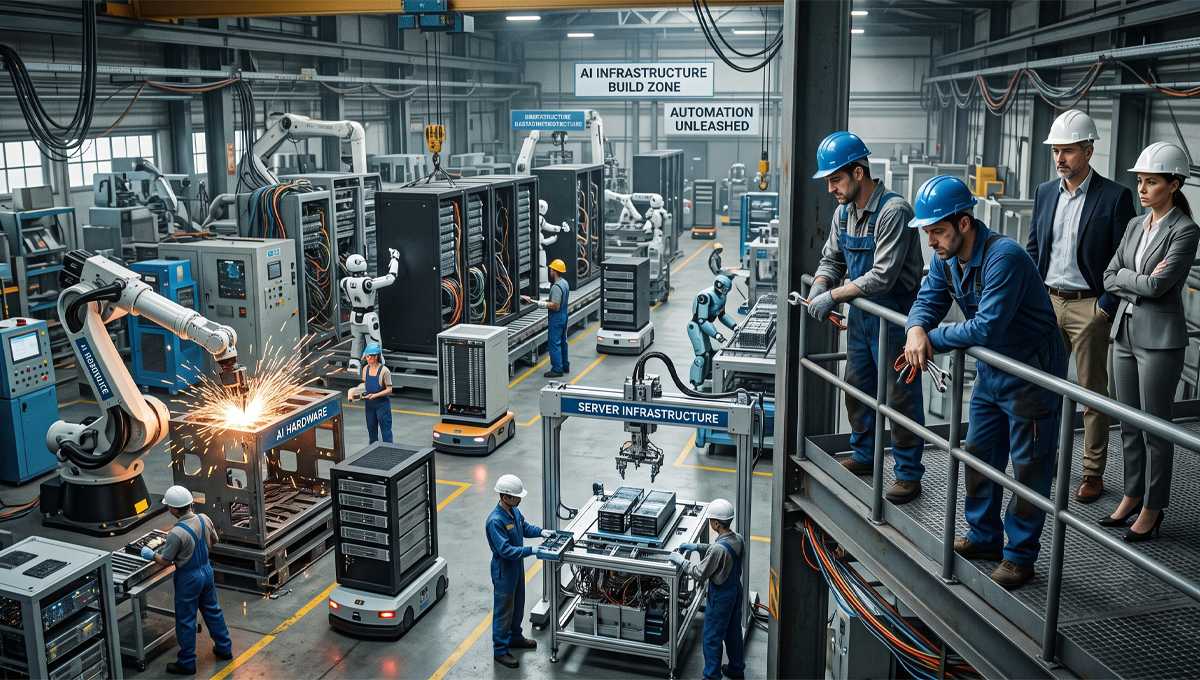
The headlines are loud. They scream about war, energy prices, and sluggish global growth. You read these reports and feel a knot in your stomach. It’s natural to worry. But you’re looking at the wrong map. If you want to secure your financial future, you need to stop staring at the general economic forecast and start looking at where the AI infrastructure is actually being built.
The economy is splitting. On one side, you have sectors struggling with energy costs and geopolitical instability. On the other, you have regions and companies riding a massive wave of technological investment. This isn’t just about software engineers in Silicon Valley. It’s about the massive supply chain of hardware, energy management, and data logistics that makes intelligence work. You don’t need to be a coder to pivot your career toward this momentum. You just need to be in the right room.
- Why the ‘AI Divide’ Matters to Your Paycheck
- Follow the Infrastructure, Not Just the Apps
- 3 Low-Tech Skills That Are Suddenly High-Value
- 1. Complex Troubleshooting
- 2. Supply Chain Orchestration
- 3. Energy Efficiency Management
- How to ‘Future-Proof’ Your Current Job Role
- The One Question to Ask in Your Next Performance Review
- Reality Check: The Skills Gap is Growing
- Action Steps to Take Today
Why the ‘AI Divide’ Matters to Your Paycheck
Think of the economy like a massive ship. When the sea gets rough, most of the vessel feels the tilt. However, the parts of the ship carrying the most valuable cargo—the chips, the servers, and the specialized energy systems—are stabilized by the sheer force of their own growth.
Key Takeaways:
* Growth is no longer tied to just geography; it’s tied to technological relevance.
* Countries and companies building physical AI hardware are thriving despite global headwinds.
* Your job security depends on whether your role touches the infrastructure of the future.
The IMF data shows something fascinating. While global growth remains modest, countries that feed the AI engine—like South Korea or Thailand—are shattering expectations. They aren’t just “lucky.” They are essential. If you want a recession-proof career, you must move away from roles that are easily replaced by generic software and toward roles that support the physical and logistical backbone of the intelligence revolution.
Follow the Infrastructure, Not Just the Apps
Everyone is obsessed with the latest chatbot or image generator. That’s the shiny surface. It’s the “app” layer. But look closer. Apps come and go. The infrastructure? That’s forever.
Think about it. Every single AI model requires massive amounts of power, specialized cooling, and sophisticated data centers. This is the hardware layer. If you work in logistics, supply chain management, facilities maintenance, or energy, you are already closer to this wave than you think.
Don’t just look for “AI” in a job description. Look for industries that provide the:
* Energy: Renewables and grid management are critical for data centers.
* Hardware: Semiconductor manufacturing and specialized electronics.
* Logistics: Moving high-value technical components across borders.
* Facilities: Building and maintaining the physical structures that house server farms.
If your industry relies on massive computing power or specialized physical parts, you are standing on the right side of the divide.
3 Low-Tech Skills That Are Suddenly High-Value
You don’t need a degree in machine learning to be useful in an AI-driven economy. In fact, the more specialized the tech gets, the more it creates a desperate need for “human-in-the-loop” skills that aren’t digital.
1. Complex Troubleshooting
Machines break. It’s a fact. When a high-tech system goes offline, an AI won’t fix it. A person who understands the physical connection between components will. If you can diagnose hardware failures or bridge the gap between “the screen is blank” and “the power supply is fried,” you are a high-value asset.
2. Supply Chain Orchestration
Moving millions of chips from one continent to another is a nightmare. It requires human judgment to navigate tariffs, shipping delays, and inventory shortages. If you understand how to move physical goods efficiently, you are doing work that an algorithm currently can’t replicate.
3. Energy Efficiency Management
Data centers burn electricity like small cities. Companies are currently obsessed with lowering their energy bills. If you have experience in facility management or industrial energy systems, you are now a consultant for the most profitable companies in the world.
How to ‘Future-Proof’ Your Current Job Role
You don’t necessarily need to quit your job to benefit from the AI infrastructure shift. You need to pivot your focus. Start by auditing your current output. How much of your day is spent on repetitive administrative tasks, and how much is spent on high-level decision-making or physical infrastructure oversight?
💡 Quick Tip: Identify the bottleneck in your department. Is it a lack of data? Is it hardware limitations? Is it poor energy management? Solve that problem, and you become the person who holds the infrastructure together.
Start documenting your results. Don’t just list “tasks completed.” List “infrastructure improvements.” Did you help migrate a legacy system to a more efficient cloud provider? Did you help organize the logistics for a hardware rollout? These are the resume bullets that matter now.
The One Question to Ask in Your Next Performance Review
You’re sitting across from your manager. The review is going well. You’ve talked about your KPIs and your goals. Now, you need to change the dynamic. Stop waiting for the company to tell you what to do.
Ask this: “How can I align my current responsibilities more closely with our technical infrastructure goals this year?”
This question does three things:
1. It shows you’re thinking about the company’s long-term survival, not just your daily to-do list.
2. It signals that you are proactive about the shifting economic landscape.
3. It forces your manager to define which projects are actually “infrastructure-critical.”
If they can’t answer, or if your role is truly disconnected from the growth areas of the company, you have your answer. It’s time to start looking elsewhere.
Reality Check: The Skills Gap is Growing
Don’t fall for the trap of thinking “everything will be automated.” The reality is quite different. The world is becoming more complex, not less. As we build more sophisticated systems, the need for human oversight increases.
🔍 Reality Check: AI is a tool, not a replacement for human judgment. The demand for people who understand the physical and logistical realities of the AI age is skyrocketing, even as basic administrative roles shrink.
The economy isn’t shrinking; it’s reallocating. It’s moving away from the abstract and toward the tangible. It’s moving away from the “fluff” and toward the “stuff.”
Action Steps to Take Today
You have the blueprint. Now, take the action.
- Audit your industry: Does your company deal in physical hardware, power, or logistics? If no, can you find a sub-department or a vendor that does?
- Upskill in physical systems: If you are in an office, learn the basics of the hardware or servers that power your software. Understand the “where” and “how” of your digital tools.
- Connect with the “builders”: Look for roles in your company that involve physical implementation or supply chain management. These people are immune to the “AI is replacing everything” panic.
- Speak the language of efficiency: Every conversation you have should center on cost-saving, energy reduction, or logistical optimization.
Stop checking the news for signs of a collapse. Start looking at your career as a piece of infrastructure. If you make yourself as essential to the engine as a power supply or a chip, you won’t just survive the economic divide. You will thrive on it.